The Story Of Lettuce from BrightFarms on Vimeo.
jeudi 29 septembre 2011
mardi 30 août 2011
VIDEO: "samen tuinieren in de stad" sur le jardin collectif des marolles aux visitanines
Half juni ontving Le Debut des Haricots het publiek in de gemeenschappelijke tuin in de Marollen. Al twee jaar lang legt de vzw Le Debut des Haricots een netwerk van ecologische moestuinen aan in België. De collectieve groentetuin tussen de Visitandinenstraat en het station Brussel-Kapellekerk zal niet alleen een uitstekend alternatief voor het aanbod van de supermarkt bieden maar wil ook de sociale contacten in de buurt stimuleren. Al loopt de participatie van de buurtbewoners niet altijd even vlot.
Bekijk hier de video.
mardi 19 juillet 2011
Agrarian urbanism the new utopia? Een bedrijfskundige kijk op stadslandbouw - door Jan Willem van der Schans
Enkele jaren geleden was urban agriculture vooral bekend als een overlevingsstrategie van de zeer armen in derde wereldsteden.
Tegenwoordig is het een begrip dat juist ook in verband gebracht wordt met
stedelijke dynamiek en vernieuwing in westerse landen.
Het onderwerp is hot. Vrijwel alle zichzelf respecterende
stedenbouwkundigen en architecten, planologen
en vastgoed ontwikkelaars hebben gebouwen, wijk of
gebiedsontwikkelingsplannen in portfolio waarbij een
vorm van voedsel productie in combinatie met stedelijke
bebouwing een rol speelt.
Dergelijke combinaties van bouwen en verbouwen, van
groen en rood, van agrarische stedelijkheid (agrarian
urbanism) zijn innovatief, hip en duurzaam. Er is een
sluimerende, soms opvlammende, voedselcrisis (voedselveiligheid
problemen, hogere grondstofprijzen, etc.),
een klimaat crisis (CO2 emissies voedselsysteem, heat
island effect in steden, etc.) en een financiële en
vastgoed crisis (teruglopende budgetten groenbeheer,
braakliggende gronden, etc.). Steden kampen met uitdagingen
als groeiende obesitas bij diverse groepen,
sociale integratie van cultureel zeer diverse bevolkingsgroepen
en het kosten effectief vitaliseren van
de wijk economie. Stadslandbouw heeft de potentie,
mits op bredere schaal en (semi-)professioneel ingezet,
op elk van deze crises en uitdagingen een begin van
een antwoord te bieden. En daarbij is het nog smakelijk
en leuk ook.
Het volledige artikel kan je hier downloaden op de website van Stedebouw en Architectuur.
Je kan op dezelfde website ook hier een brochure "Smakelijk duurzame stad" downloaden, aangeboden door het Nederlandse ministerie van Economische Zaken, Landbouw en Innovatie, een magazine over gemeentelijke ‘voedselstrategie’, over ‘stadslandbouw’, ‘voedselparken’, moestuinen, streekproducten, en over voorlichting op scholen.
Tegenwoordig is het een begrip dat juist ook in verband gebracht wordt met
stedelijke dynamiek en vernieuwing in westerse landen.
Het onderwerp is hot. Vrijwel alle zichzelf respecterende
stedenbouwkundigen en architecten, planologen
en vastgoed ontwikkelaars hebben gebouwen, wijk of
gebiedsontwikkelingsplannen in portfolio waarbij een
vorm van voedsel productie in combinatie met stedelijke
bebouwing een rol speelt.
Dergelijke combinaties van bouwen en verbouwen, van
groen en rood, van agrarische stedelijkheid (agrarian
urbanism) zijn innovatief, hip en duurzaam. Er is een
sluimerende, soms opvlammende, voedselcrisis (voedselveiligheid
problemen, hogere grondstofprijzen, etc.),
een klimaat crisis (CO2 emissies voedselsysteem, heat
island effect in steden, etc.) en een financiële en
vastgoed crisis (teruglopende budgetten groenbeheer,
braakliggende gronden, etc.). Steden kampen met uitdagingen
als groeiende obesitas bij diverse groepen,
sociale integratie van cultureel zeer diverse bevolkingsgroepen
en het kosten effectief vitaliseren van
de wijk economie. Stadslandbouw heeft de potentie,
mits op bredere schaal en (semi-)professioneel ingezet,
op elk van deze crises en uitdagingen een begin van
een antwoord te bieden. En daarbij is het nog smakelijk
en leuk ook.
Het volledige artikel kan je hier downloaden op de website van Stedebouw en Architectuur.
Je kan op dezelfde website ook hier een brochure "Smakelijk duurzame stad" downloaden, aangeboden door het Nederlandse ministerie van Economische Zaken, Landbouw en Innovatie, een magazine over gemeentelijke ‘voedselstrategie’, over ‘stadslandbouw’, ‘voedselparken’, moestuinen, streekproducten, en over voorlichting op scholen.
Libellés :
stedelijke landbouw
vendredi 12 février 2010
How to feed a city
How to feed a city

READ HERE THE ARTICLE FROM THE ECOLOGIST
Carolyn Steel
1st June, 2009
We can continue to squander our resources and react to food crises as they happen, or we can fundamentally change the way the food systems work, says Carolyn Steel
Sitopia is really a state of mind; a way of recalibrating the values by which we live. It privileges food.
Feeding cities has never been easy. On the contrary, it could be described as mankind’s oldest self-imposed dilemma. The problem is that even though people living in cities don’t tend to produce their own food, whether they realise it or not, they still dwell on the land. The resultant distance (in all senses) between city-dwellers and their food is a paradox at the core of civilisation; resolving it is the greatest challenge of our time.
Cities have been around for some 5,500 years, yet for most of that period the number of people who lived in them represented a tiny fraction of the global population. In 1800, just three per cent lived in towns of 5,000 inhabitants or more. Today that figure is more than half. Three billion already live in cities, and a further three billion are expected to join them by 2050. If so many are to be fed on current principles, the threat to global reserves of oil, water, fish, soil and rainforest – to say nothing of the climate change associated with plundering those reserves – is stark.
A few statistics state the case: 95 per cent of the food we eat today is oil-dependent, yet peak oil is imminent; 70 per cent of global freshwater is used for agriculture,...
To view the rest of this article - you must be a paying subscriber and Login

READ HERE THE ARTICLE FROM THE ECOLOGIST
Carolyn Steel
1st June, 2009
We can continue to squander our resources and react to food crises as they happen, or we can fundamentally change the way the food systems work, says Carolyn Steel
Sitopia is really a state of mind; a way of recalibrating the values by which we live. It privileges food.
Feeding cities has never been easy. On the contrary, it could be described as mankind’s oldest self-imposed dilemma. The problem is that even though people living in cities don’t tend to produce their own food, whether they realise it or not, they still dwell on the land. The resultant distance (in all senses) between city-dwellers and their food is a paradox at the core of civilisation; resolving it is the greatest challenge of our time.
Cities have been around for some 5,500 years, yet for most of that period the number of people who lived in them represented a tiny fraction of the global population. In 1800, just three per cent lived in towns of 5,000 inhabitants or more. Today that figure is more than half. Three billion already live in cities, and a further three billion are expected to join them by 2050. If so many are to be fed on current principles, the threat to global reserves of oil, water, fish, soil and rainforest – to say nothing of the climate change associated with plundering those reserves – is stark.
A few statistics state the case: 95 per cent of the food we eat today is oil-dependent, yet peak oil is imminent; 70 per cent of global freshwater is used for agriculture,...
To view the rest of this article - you must be a paying subscriber and Login
lundi 28 décembre 2009
vendredi 18 septembre 2009
mercredi 16 septembre 2009
PROJECT 8m²: Verover 8 vierkante meter publieke ruimte op de auto
Als een stadsbewoner ervoor kiest een auto te bezitten, kan hij een bewonerskaart krijgen waarmee hij in de wijk gratis kan parkeren en dus 8m2 van de openbare ruimte inpalmt voor privégebruik. Een niet gemotoriseerde stadsbewoner kan niet van dat voordeel genieten.
Het project “8m2” vestigt hier de aandacht op en toont aan dat deze 8m2 gebruikt kan worden voor heel wat dingen die een stuk aangenamer of nuttiger zijn voor het leven in de stad. Verschillende inwoners van Sint- Gillis grijpen de Week van Vervoering aan om een sensibiliseringsactie op te zetten en palmen met mobiele moestuintjes van 8m2 de straten van Sint-Gillis in.
Maar met hun actie willen de deelnemers van het projet “8m²” verder gaan dan sensibiliseren. Het project is een boodschap aan hun gemeentebestuur: ze willen eenzelfde deel van de openbare ruimte kunnen gebruiken als hun medeburgers met een auto.
Tijdens de Autoloze Zondag zullen de deelnemers van het project “8m²” alternatieve bewonerskaarten uitdelen, waarop voorbijgangers hun ideeën kunnen schrijven voor een gezelliger en milieuvriendelijker gebruik van een “ordinaire” parkeerplaats. Die “alternatieve parkeerkaarten” zullen ze overhandigen aan het gemeentebestuur.
Het project “8m2” vestigt hier de aandacht op en toont aan dat deze 8m2 gebruikt kan worden voor heel wat dingen die een stuk aangenamer of nuttiger zijn voor het leven in de stad. Verschillende inwoners van Sint- Gillis grijpen de Week van Vervoering aan om een sensibiliseringsactie op te zetten en palmen met mobiele moestuintjes van 8m2 de straten van Sint-Gillis in.
Maar met hun actie willen de deelnemers van het projet “8m²” verder gaan dan sensibiliseren. Het project is een boodschap aan hun gemeentebestuur: ze willen eenzelfde deel van de openbare ruimte kunnen gebruiken als hun medeburgers met een auto.
Tijdens de Autoloze Zondag zullen de deelnemers van het project “8m²” alternatieve bewonerskaarten uitdelen, waarop voorbijgangers hun ideeën kunnen schrijven voor een gezelliger en milieuvriendelijker gebruik van een “ordinaire” parkeerplaats. Die “alternatieve parkeerkaarten” zullen ze overhandigen aan het gemeentebestuur.
PROJET 8m² : regagner 8 m² d’espace public sur la voiture
En ville, lorsqu’un habitant choisit de posséder une voiture, il peut obtenir une carte de riverain qui lui permet de stationner gratuitement dans le quartier, ce qui entraîne l’utilisation privative d’environ 8m2 d’espace public. Un riverain non motorisé, par contre, ne disposera pas de cet avantage.
Le projet “8m2” vise à attirer l’attention sur cette situation et à démontrer que ces 8m2 dévolus à l’automobile pourraient être utilisés à des fins plus agréables ou utiles. Le collectif d’habitants de Saint-Gilles profite de la Semaine de la Mobilité pour lancer une action de sensibilisation en créant des jardins potagers de 8m2 dans les rues de leur commune.
Mais l’action du collectif veut aller plus loin que la sensibilisation et porte aussi une revendication, car c’est notamment au niveau de la commune que la gestion de l’espace public se décide.
Avec le « projet 8m² » le collectif veut donc passer un message à leur conseil communal : piétons et cyclistes revendiquent le droit de pouvoir occuper la même portion d’espace public que leurs concitoyens qui choisissent de posséder une voiture.
Pendant le Dimanche sans voiture, le collectif distribuera des «cartes de riverain alternatives » sur lesquelles les passants pourront partager leurs idées pour un usage de l’espace public plus convivial et respectueux de l’environnement qu’un « bête » emplacement parking. Les « cartes de riverain alternatives » seront ensuite remises au conseil communal.
REGARDEZ LE REPORTAGE DE Télébruxelles ICI
Le projet “8m2” vise à attirer l’attention sur cette situation et à démontrer que ces 8m2 dévolus à l’automobile pourraient être utilisés à des fins plus agréables ou utiles. Le collectif d’habitants de Saint-Gilles profite de la Semaine de la Mobilité pour lancer une action de sensibilisation en créant des jardins potagers de 8m2 dans les rues de leur commune.
Mais l’action du collectif veut aller plus loin que la sensibilisation et porte aussi une revendication, car c’est notamment au niveau de la commune que la gestion de l’espace public se décide.
Avec le « projet 8m² » le collectif veut donc passer un message à leur conseil communal : piétons et cyclistes revendiquent le droit de pouvoir occuper la même portion d’espace public que leurs concitoyens qui choisissent de posséder une voiture.
Pendant le Dimanche sans voiture, le collectif distribuera des «cartes de riverain alternatives » sur lesquelles les passants pourront partager leurs idées pour un usage de l’espace public plus convivial et respectueux de l’environnement qu’un « bête » emplacement parking. Les « cartes de riverain alternatives » seront ensuite remises au conseil communal.
REGARDEZ LE REPORTAGE DE Télébruxelles ICI
dimanche 6 septembre 2009
samedi 20 juin 2009
Number of world's hungry to top 1 billion this year – UN food agency
- The urban poor will likely be hardest hit by the global recession
- Many of the world's hungry are smallholder farms who have the potential to feed themselves and also boost global food security, said Kanayo F. Nwanze, President of the International Fund for Agricultural Development (IFAD).
“To unleash this potential and reduce the number of hungry people in the world, governments, supported by the international community, need to protect core investments in agriculture so that smallholder farmers have access not only to seeds and fertilizers but to tailored technologies, infrastructure, rural finance, and markets,” he added.
The UN press release
and also:
"Jamaica says poverty and hunger will never be eradicated if the creation of wealth is pursued at the expense of social justice"
listen here
- Many of the world's hungry are smallholder farms who have the potential to feed themselves and also boost global food security, said Kanayo F. Nwanze, President of the International Fund for Agricultural Development (IFAD).
“To unleash this potential and reduce the number of hungry people in the world, governments, supported by the international community, need to protect core investments in agriculture so that smallholder farmers have access not only to seeds and fertilizers but to tailored technologies, infrastructure, rural finance, and markets,” he added.
The UN press release
and also:
"Jamaica says poverty and hunger will never be eradicated if the creation of wealth is pursued at the expense of social justice"
listen here
mardi 16 juin 2009
ça pousse et ça roule
Cliquez ICI pour voir plus de photos

En plus des bacs en frigolite (récup du poissonier) qu'on utulisait sur la terrasse du bureau de Friends of the Earth Europe, on utulise maintenant des bacs un peu plus grands.
Du coup, les courges poussent beaucoup mieux.

On récupère aussi l'eau de pluie. Il y a moyen de trouver des grands reservoirs d'eau comme celle-ci sur le net pour 50 euros.

ça pousse donc bien, et grace aux roulettes sous les bacs, ça roule aussi!

Le jardin collectif, un lieu pour cultiver des plans de revolution.

une jeune subversive

Cliquez ICI pour voir plus de photos
En plus des bacs en frigolite (récup du poissonier) qu'on utulisait sur la terrasse du bureau de Friends of the Earth Europe, on utulise maintenant des bacs un peu plus grands.
Du coup, les courges poussent beaucoup mieux.
On récupère aussi l'eau de pluie. Il y a moyen de trouver des grands reservoirs d'eau comme celle-ci sur le net pour 50 euros.
ça pousse donc bien, et grace aux roulettes sous les bacs, ça roule aussi!
Le jardin collectif, un lieu pour cultiver des plans de revolution.
une jeune subversive
Cliquez ICI pour voir plus de photos
dimanche 15 février 2009
après le RECYclart, la voiture potager s'est recyclé
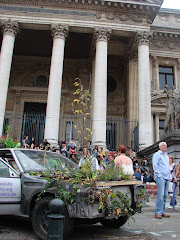
Après la maison de mai, la voiture potager a transformé pendant un mois un emplacement parking en face du RECYclart.
(Sans le soutien de l'asbl Recylart. Malgré le "recyclage" dans le nom de leur asbl, le recyclart n'aimait pas trop la voiture potager en fait. Déjà après une semaine le recyclart voulait appeller Bruxelles proprété pour envoyer la voiture potager à la poubelle.)
Après un voyage de deux ans, pendant laquelle la voiture potager a visité plusieurs coins de Bruxelles, la voiture potager s'est enfin recyclé.
Le fin s'est anoncé par un e-mail que le festivaldesarts nous avait envoyé, nous disant qu'ils avaient besoin du parking, et que la "veille volvo" devait se casser du parking. La voiture potager s'est donc vu obligé de se casser vers la casse.
Le moment ou on était entrain de virer la terre de la voiture potager, des habitants du quartier nous ont spontané offert un coup de main (merci pour le coup de main et la rencontre Mohammed!). Une voiture dans laquelle poussaient des salades, ça changait un peu, nous ont-il dit.
Et que on devrait mettre plusieurs voitures potagers dans la ville, à differents endroits.
dimanche 21 septembre 2008
l'image du voiture potager continue de parler à l'imagination
L'image du voiture potager continue de parler à l'imagination
Même si cette année ci la voiture potager et le projet www.auto-suffisance.be n'ont pas fait leur apparence dans le centre ville comme pour la journée sans voiture 2007, quelques médias l'ont utulisé comme image symbolique pour annoncer la journée sans voiture 2008.

Chaque année une journée sans voitures dans la ville fait rêver les habitants de nos rues. Imagine tous ce qu'on pourrait faire de notre ville si on pourrait se reveiller de cette cauchemar du bruit et pics de pollution!
Même si cette année ci la voiture potager et le projet www.auto-suffisance.be n'ont pas fait leur apparence dans le centre ville comme pour la journée sans voiture 2007, quelques médias l'ont utulisé comme image symbolique pour annoncer la journée sans voiture 2008.

Chaque année une journée sans voitures dans la ville fait rêver les habitants de nos rues. Imagine tous ce qu'on pourrait faire de notre ville si on pourrait se reveiller de cette cauchemar du bruit et pics de pollution!
dimanche 27 juillet 2008
L'esprit de mai a sauvé la voiture potager!
La voiture potager continue de vivre dans l'esprit de mai, non seulement dans les pensées, mais en réalité! (http://www.lespritdemai.com/)
Un grand merci à tous les gens qui ont diffusé l'appel, merci à "Le Soir" et "La Capitale" d'avoir diffusé l'appel dans un article, un très grand merci aux gens qui nous ont contacté avec de nouvelles pistes, et un très grand merci à Jacky de "l'esprit de mai" et à Lucrèce des "jardins solidaires" d'avoir pris en charge le déplacement de la voiture potager pendant qu'Aline et moi on n'était pas là!

Jusqu'à la fin du projet "l'esprit de mai" (fin octobre), la voiture potager restera à son nouvel emplacement, au croisement de l'Avenue de la Couronne et de l'Avenue Rodin à Ixelles (Bruxelles).
Ceci veut dire que nous continuons à chercher un endroit où la voiture potager pourra s'enraciner pour de vrai.


Le pommier de la voiture potager donne ses premières pommes!

On continue à jardiner dans la voiture potager. Son équipement standard offre de la moutarde, la menthe fraîche, des herbes aromotiques, des fraises, des choux, du persil, des orties, et bientôt des tomates et de la salade!
La voiture potager continue de vivre dans l'esprit de mai, non seulement dans les pensées, mais en réalité! (http://www.lespritdemai.com/)
Un grand merci à tous les gens qui ont diffusé l'appel, merci à "Le Soir" et "La Capitale" d'avoir diffusé l'appel dans un article, un très grand merci aux gens qui nous ont contacté avec de nouvelles pistes, et un très grand merci à Jacky de "l'esprit de mai" et à Lucrèce des "jardins solidaires" d'avoir pris en charge le déplacement de la voiture potager pendant qu'Aline et moi on n'était pas là!
Jusqu'à la fin du projet "l'esprit de mai" (fin octobre), la voiture potager restera à son nouvel emplacement, au croisement de l'Avenue de la Couronne et de l'Avenue Rodin à Ixelles (Bruxelles).
Ceci veut dire que nous continuons à chercher un endroit où la voiture potager pourra s'enraciner pour de vrai.
Le pommier de la voiture potager donne ses premières pommes!
On continue à jardiner dans la voiture potager. Son équipement standard offre de la moutarde, la menthe fraîche, des herbes aromotiques, des fraises, des choux, du persil, des orties, et bientôt des tomates et de la salade!
vendredi 4 juillet 2008
samedi 28 juin 2008
appel URGENT: la fin ou la renaissence de la voiture potager? ça ce décide MAINTENANT

Bonjour tous,
voici un appèl URGENT:
Peut-être vous connaissez la voiture potager, qui était sur le boulevard Anspach à Bruxelles pendant la semaine de la mobilité en 2007, et sur la place de la bourse pendant le dimanche sans voitures. Peut-être que si vous voyez les photo's, sa vous dirait quelque chose.
Cette vraie 'voiture du futur', fait le parti le plus essentiel du projet de sensibilistation auto-suffisance (voir www.auto-suffisance.be)
Après la semaine de la mobilité, nous avons repoussé la voiture potager de nouveau vers le site de la battellerie près du site de Tour et Taxis, ou on l'avait transformé en voiture verte (la seule vraie façon de la faire). Là, elle est resté devant la battellerie sur le trotoir, car le BULEX asbl, qui avait eu la gentillesse pour nous prêter un coin sur la cour de la battellerie, préferais qu'elle ne rentrait plus dans la cour.
La voiture potager est donc resté là pendant des mois, des mois pendant lesquelles lesquelles les initieurs du projet ont cherché un endroit ou on pouvait implanter le potager mobile, sans succès. Nous avons démandé entre autre aux proprios du site de Tour et Taxis, sans jamais avoir eu de réponse. Aussi quelques autres pistes n'ont pas abouti à une possibilité pour enraciner la voiture potager.
Finalement il semble que, malgré ce que affirment les automobilistent, il est facile de trouver une place pour garer sa voiture en milieu urbain, mais qu'une voiture qui héberge un pommier là ou des autres voiturezs cachent un moteur à combustion, ne trouve pas de petit coin pour faire pousser ses tomates et epices en paix.
Aujourd'hui j'ai eu un appel de BULEX asbl, que la police est passé ce matin par la batellerie et qu' ils étaient sur le point d'enlever la voiture potager, pour l'emmener a la casse, et qu'ils allaient envoyer le la facture pour le depannage à nous (Aline et moi sans doute, vu le fait que nous sommes les personnes indiqué sur le site web de www.auto-suffisance.be )
Aline a donc appelé la police, et elle a obtenue un delai d'une semaine pour trouver une solution et pour deplacer la voiture nous même.
Si nous avons pas trouvé de solution dans ce delai, la police enlèverait la voiture pour l''emmener à la casse, et va nous envoyer le facture pour le depannage.
Nous avons donc deux options:
Nous enlèvons pendant la semaine le terreau, le pommier et toutes les plantes que Aline et moi vennaient de replanter dans la voiture, et nous appellons le ferailleur pour venir chercher la voiture, et on est triste que la fin du voiture potager soit aussi symbolique que le projet sur soi même.
Nous choissisons de relancer le projet et de garder la voiture potager. Pour ça il faut qu'on trouve un endroit ou la voiture potager peut s'enraciner. Si vous connaissez un endroit, ou si vous avez un coin que vous voulez dédiquer à un symbole blasphémique de l'automobilité, vous avez le pouvoir de sauver ce rève.
Si des gens entre vous sont aussi touché par la symbolique du projet que nous on l'est, et qui se lèvent pour activement soutenir le projet, le projet peut continuer à insulter la dominance de l'asphalte, car Aline et moi ne pouvons pas nous occuper du projet toute seule.
Concrètement il y aura besoin que quelques gens entre vous qui s'activent cette semaine pour trouver une solution ou la voiture potager peut s'enraciner. Aline et moi partent en vacance le 4 juillet jusqu'au 28, et malheureusement moi je suis vraiment super débordé au boulot avant de partir, et je pourrai donc pas faire grand chose.
En bref, si vous voulez REsémer les graines pour une ville verte et nourrisière (le slogan du projet auto-suffisance) , c'est le tout dernier moment.
le projet:
www.auto-suffisance.be
qques retours dans les medias: http://www.lesoir.be/regions/bruxelles/la-voiture-potager-pousse-en-2007-09-19-550324.shtml


mercredi 17 octobre 2007
Chapter 3: Farming the Cities

Preface on Our Urban Future:
http://www.worldwatch.org/node/4852
source: http://www.worldwatch.org/node/4832
Chapter 3: Farming the Cities
-Brian Halweil and Danielle Nierenberg
Growing food and raising fish and livestock in cities is nothing new. In some ways, cities are responding to the same challenges that urban gardeners have faced for millennia. The hanging gardens in Babylon, for instance, were an example of urban agriculture, while residents of the first cities of ancient Iran, Syria, and Iraq produced vegetables in home gardens. This is partly because cities have traditionally sprung up on the best farmland: the same flat land that is good for farming is also easiest for constructing office buildings, condominiums, and factories . The masses of urban dwellers also create a perfect market for fresh fruits and vegetables.
Despite all that farming can do for the city landscape and the urban soul, politicians, businesses, and planners continue to regard food as a rural issue that does not demand the same attention as housing, crime, or transportation. Policymakers would be wise to realize the nutritional, social, ecological, and economic benefits of reversing this mindset and putting programs in place to encourage cities to feed themselves. Fortunately, urban politicians, businesses, and planners are beginning to regard urban agriculture as a tool to help cities cope with a range of ecological, social, and nutritional challenges—from sprawl and malnutrition to swelling landfills and the threat of attacks on the food chain.
Brian Halweil is a Senior Researcher and Danielle Nierenberg is a Research Associate at the Worldwatch Institute.
Libellés :
Urban farming future
Human urine is a good food fertilizer
KUOPIO, Finland, Oct. 8 (UPI) -- Finnish scientists have discovered an inexpensive, abundantly available, effective and undeniably organic crop fertilizer: human urine.
Although urine has been used as fertilizer since ancient times, its use is rare today. However, it has gained attention in some areas as farmers increasingly embrace organic production methods and try to reduce use of synthetic fertilizers.
The scientists noted urine from healthy individuals is virtually sterile, free of bacteria or viruses and naturally rich in nitrogen and other nutrients.
In the new study, University of Kuopio scientists Surendra Pradhan, Helvi Heinonen-Tanski and colleagues collected human urine from private homes and used it to fertilize cabbage crops. Then they compared the urine-fertilized crops with those grown using conventional industrial fertilizer and no fertilizer.
The analysis showed growth and biomass were slightly higher with urine than with conventional fertilizer. There was no difference in nutritional value of the cabbage.
"Our results show that human urine could be used as a fertilizer for cabbage and does not pose any significant hygienic threats or leave any distinctive flavor in food products," the scientists said.
The study is to be reported in the Journal of Agricultural and Food Chemistry.
Copyright 2007 by United Press International. All Rights Reserved
KUOPIO, Finland, Oct. 8 (UPI) -- Finnish scientists have discovered an inexpensive, abundantly available, effective and undeniably organic crop fertilizer: human urine.
Although urine has been used as fertilizer since ancient times, its use is rare today. However, it has gained attention in some areas as farmers increasingly embrace organic production methods and try to reduce use of synthetic fertilizers.
The scientists noted urine from healthy individuals is virtually sterile, free of bacteria or viruses and naturally rich in nitrogen and other nutrients.
In the new study, University of Kuopio scientists Surendra Pradhan, Helvi Heinonen-Tanski and colleagues collected human urine from private homes and used it to fertilize cabbage crops. Then they compared the urine-fertilized crops with those grown using conventional industrial fertilizer and no fertilizer.
The analysis showed growth and biomass were slightly higher with urine than with conventional fertilizer. There was no difference in nutritional value of the cabbage.
"Our results show that human urine could be used as a fertilizer for cabbage and does not pose any significant hygienic threats or leave any distinctive flavor in food products," the scientists said.
The study is to be reported in the Journal of Agricultural and Food Chemistry.
Copyright 2007 by United Press International. All Rights Reserved
Real organic agriculture: Using human waste as fertilizer
source: http://www.worldwatch.org/node/5394
The other day, I got some funny looks from a journalist who was interviewing me for an upcoming series on World Food Day. She asked me to list some of the ways I thought world hunger could be reduced. In addition to pointing to the need for better distribution of food and other resources, I gave my standard spiel about growing more food in cities. About half of the world’s population now lives in cities, which makes growing food there not just a hobby for wealthy urbanites, but an essential step in improving the health of the urban poor. But what made the journalist look askance was my description of how exactly urban farmers in some parts of the world are fertilizing their crops: with human manure and urine.
It may be hard for some of us to stomach, but much of the food grown in developing-world cities is irrigated with waste water. According to the International Water Management Institute, the reason is very simple—water from sewage systems is a low-cost, nutrient-rich source of irrigation for the urban poor. As a result, worldwide, 3.5 to 4.5 million hectares of land are irrigated with poop and pee. And while this sort of “waste” water can contain a whole range of pathogens, farmers can learn to use it safely. In fact, a Finnish study released earlier this week found that using human urine for irrigation can slightly increase plant growth (they used cabbages) and does not affect the nutritional value of the crop. In other words, urine can replace costly store-bought fertilizers and produce nutritious, organically grown food.
Although farmers have used human waste as fertilizer for centuries, cities and governments have more recently looked down on the practice. But in countries like Ghana, officials do not have the money or infrastructure to provide alternatives. In Accra, for example, 200,000 people a day eat salad from land irrigated with urine and human manure. But while this helps provide these folks a diversified diet, it also gives a sense of how many people may be at risk from polluted water. Educating farmers on how to grow, wash, and prepare urban food safely and educating policymakers about the agricultural and economic benefits of human waste will help ensure that millions of urban dwellers don’t go hungry.
The other day, I got some funny looks from a journalist who was interviewing me for an upcoming series on World Food Day. She asked me to list some of the ways I thought world hunger could be reduced. In addition to pointing to the need for better distribution of food and other resources, I gave my standard spiel about growing more food in cities. About half of the world’s population now lives in cities, which makes growing food there not just a hobby for wealthy urbanites, but an essential step in improving the health of the urban poor. But what made the journalist look askance was my description of how exactly urban farmers in some parts of the world are fertilizing their crops: with human manure and urine.
It may be hard for some of us to stomach, but much of the food grown in developing-world cities is irrigated with waste water. According to the International Water Management Institute, the reason is very simple—water from sewage systems is a low-cost, nutrient-rich source of irrigation for the urban poor. As a result, worldwide, 3.5 to 4.5 million hectares of land are irrigated with poop and pee. And while this sort of “waste” water can contain a whole range of pathogens, farmers can learn to use it safely. In fact, a Finnish study released earlier this week found that using human urine for irrigation can slightly increase plant growth (they used cabbages) and does not affect the nutritional value of the crop. In other words, urine can replace costly store-bought fertilizers and produce nutritious, organically grown food.
Although farmers have used human waste as fertilizer for centuries, cities and governments have more recently looked down on the practice. But in countries like Ghana, officials do not have the money or infrastructure to provide alternatives. In Accra, for example, 200,000 people a day eat salad from land irrigated with urine and human manure. But while this helps provide these folks a diversified diet, it also gives a sense of how many people may be at risk from polluted water. Educating farmers on how to grow, wash, and prepare urban food safely and educating policymakers about the agricultural and economic benefits of human waste will help ensure that millions of urban dwellers don’t go hungry.
mardi 10 juillet 2007
et Yannick à envoyé cette lien vers un BD de Gaston Lagaffe http://airbrbio.free.fr/divers/gaston_lierre_1.jpg
Inscription à :
Messages (Atom)